
High-Impact Seminars
Duren Professorship

The William L. Duren 2026 Professorship supports new, intellectually engaging, semester-long “dream courses.” Newcomb Tulane College awards faculty based on their commitment to undergraduate teaching, scholarly and artistic achievement, and the development of an innovative course. Established by distinguished mathematician and academic leader William L. Duren, this endowment provides faculty with the resources to create a unique learning experience that would never have been possible within the confines of the traditional curriculum.
The Department of Biomedical Engineering made significant changes to the professional practice sequence in Biomedical Engineering to one that is tailored to the student’s career goals and provides flexibility to fit varying backgrounds and timelines. The course allows students and faculty to leverage industry insider information to prepare students for success in whichever careers they choose to pursue. The new course includes the application of the Entrepreneurial Minded Learning framework, offering students the flexibility to pursue industry co-ops, clinical shadowing, or traditional research. This professional experience course will be a transformational step in providing students with the exact exposure and experience that they need to be successful in industry, clinical, research, and academic roles. Students will have expanded options to professional experiences that have a direct pathway to desired careers after graduation. This course was developed by Dr. Khaled Adjerid.
Why is the Pythagorean theorem so important in the history of geometry? What did ancient doctors know about the human nervous system? How did ancient astronomers explain the retrograde motion of planets? Students in a newly designed course, “Ancient Science: The Seeds of Discovery” will have access to transformative hands-on learning experiences to explore these questions and more. Professor Panteri is bringing the foundational concepts of ancient science to life by transforming the classroom into a laboratory of historical innovation. Through an immersive partnership in the Scot Ackerman MakerSpace, students co-develop working replicas of revolutionary devices like Archimedes' screw to move Greco-Roman engineering off the page and into their hands. This interdisciplinary venture culminates in a public exhibition at the Tulane Special Collections Library, preparing students across all fields to see the world through the combined lenses of the philosopher and the engineer. This course was developed by Dr. Sara Panteri.
Course-based Undergraduate Research Experiences (CUREs)

CURE courses expand boundaries of the traditional classroom by replacing passive learning with active discovery, empowering students to develop sophisticated research methodologies and professional communication skills through applied, real-world inquiry. In CURE courses, the entire class collaborates on an active research project with unknown outcomes. Guided by faculty mentors, students learn to navigate the research process, gather authentic data, and produce novel findings.
BMEN 6661 - Applied Biomaterials and Transport Lab
Design filters for safe drinking water. Addressing a critical global health challenge, this course turns the teaching lab into a functional Research & Development facility. Students will synthesize and test granular hydrogels to create low-cost, point-of-use filtration systems. The course culminates in a collaboratively authored manuscript, with the potential for student designs to be deployed during the BME service-learning trip to Sierra Leone. The course instructor is Mykel Green (Biomedical Engineering).
ECON 4971 - Discrimination & Data Research Project
Quantifying inequality through field experiments. Why does discrimination occur? Students answer this by stepping into the role of a quantitative social science researcher. Students will use data (some of which they will help collect) from audit field experiments that measure discrimination in access to housing, education, and healthcare. Students will then use this data to answer their own hypotheses as to why discrimination occurs, such as if state policies affect discrimination, or if certain types of people or institutions discriminate more. To test their hypotheses, students will be guided through collecting data, merging their data into the field experiment dataset, applying statistical analysis, and communicating research results. Students will aim to produce a publishable paper that provides insights into why discrimination occurs, and what could potentially reduce it. The course instructor is Patrick Button (Economics).
Core Colloquia
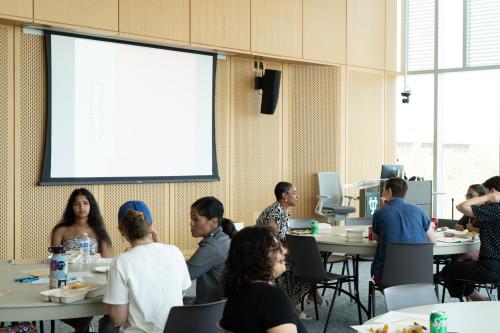
Core Colloquia are dynamic, three-credit first-year seminars designed to ignite intellectual curiosity from the very first day on campus. These faculty-led courses move beyond the mastery of facts to model the rigorous modes of inquiry and durable academic habits required to navigate Tulane's core curriculum. By using compelling, specialized topics as a vehicle for methodology, these seminars ensure that first-year students embark on their collegiate journey with the tools to uncover deep fascination in any field of study.
These courses also satisfy the First-Year Seminar Core Curriculum requirement.
GESS 2190 - Hurricane Katrina: Intersectional Approaches to Environmental Justice, Disaster, and Public Policy | Professor Sina Lee | MWF 12-12:50 p.m.
Attributes: Textual & Historical Perspectives; Race & Inclusion
Was Hurricane Katrina a natural disaster or a man-made one? In this course, students use intersectional feminist tools to challenge dominant narratives of the storm. By analyzing oral histories, documentaries, and local case studies, we examine how structural vulnerability shaped disaster and recovery. The course highlights the leadership, experiences, and community work of Women of Color in the aftermath of Katrina and considers how public policy continues to shape life in New Orleans today.
HISA 1500 - Dante’s Divine Comedy | Professor F. Thomas Luongo | MWF 1-1:50 p.m.
Attributes: Textual & Historical Perspectives; Global Perspectives; Writing Tier I
An immersive journey through a vision of the afterlife that is also an “encyclopedia” of the medieval world. Features a “student-expert” model: each student masters a specific theme—from astronomy to politics—and leads the class as they traverse the text of The Divine Comedy.
HIST 1500 - Digital History & Slavery | Professor Laura Adderley | M 3-5:30 p.m.
Attributes: Textual & Historical Perspectives; Race & Inclusion; Writing Tier I
What does the history of slavery and race have to do with modern digital data? Students investigate the dehumanizing intent of slavery-era data collection, and the ethics of modern digital archives. The course will explore large public databases related slave trading and slavery, including some databases directly related to slavery history in New Orleans.
HIST 1520 - Pain & Torture Through History | Professor Linda Pollock | W 3-5:30 p.m.
Attributes: Textual & Historical Perspectives; Global Perspectives; Writing Tier I
An examination of the goals and consequences of torture through history, as it moved from a focus of inflicting pain to the use of psychological torture and sensory deprivation. Students will explore what makes a person into a torturer, the effect torture has on victims and communities, and why countries that signed the UN declaration banning torture still practice it along with the ramifications of this.
HISU 1500 - New Orleans and Its Environment in History | Professor Brad Bolman | F 12:15-2:45 p.m.
Attributes: Textual & Historical Perspectives; Writing Tier I
Grounding students in their new home. This course asks how the environment has shaped New Orleans—and how humans have engineered the landscape. The city itself becomes the archive as students observe the local environment to understand the history beneath their feet.
MATH 1661 - Explorations in Variant Sudoku | Professor Michael Joyce I MWF 12-12:50 p.m.
Attribute: Formal Reasoning
A masterclass in logic without the barrier of advanced prerequisite knowledge in mathematics. Students develop perseverance and high-level deductive reasoning by analyzing “Variant Sudoku”—complex logic puzzles that require rigorous proof rather than guesswork.
These immersive courses replace passive learning with active discovery, empowering students to develop sophisticated research methodologies and professional communication skills through applied, real-world inquiry. By integrating faculty-mentored projects directly into the curriculum, CUREs provide an early-career launchpad that builds the confidence and technical self-efficacy essential for long-term scholarly success.
HISC 1500 - Divorce in Maoist China: Archives in Action | Professor Brian DeMare I R 12:30-3 p.m.
Attributes: Textual & Historical Perspectives; Global Perspectives; Writing Tier I
The Project: AI-powered history. In a “first of its kind” seminar, students use AI tools to translate and analyze a rare collection of Chinese-language archives regarding the 1953 Marriage Law Campaign. This innovative approach allows students without language skills to unlock historical “silences.”
HISU 1501 - Black Wall Streets | Professor Shennette Garrett-Scott | M 12:15-2:45 p.m.
Attributes: Textual & Historical Perspectives; Race & Inclusion; Writing Tier I
The Project: Reclaiming economic history. Students investigate the rise, fall, and future of historic Black business districts, including Richmond, Tulsa, and Mound Bayou, MS. The course results in a public-facing project that integrates oral histories and digital humanities to map these spaces of economic resilience.
MATH 1660 - Modeling Campus Life | Professor Lifeng Han | MWF 11-11:50 a.m.
Attribute: Formal Reasoning
The Project: Turn everyday campus moments into real research! Investigate dining-hall crowds, study habits, pedestrian flow, and more using data you collect and mathematical models you build. No predetermined answers, just genuine discovery. Own your research question, design your study, and present original findings.
SPHU 2810 - Collaborative Molecular Epidemiology | Claudia Herrera | TR 9:30-10:45 a.m.
Attribute: Mathematics & Natural Sciences
The Project: Real data, unknown outcomes. Students step into the role of molecular epidemiologists, analyzing authentic surveillance records of neglected tropical diseases like Trypanosoma cruzi explore patterns in disease transmission.
